
The first lecture was approaching.
If she lingered at the refectory any longer, she would either start conjuring Samantha at every doorway or prove she had become exactly the sort of melodramatic fool Samantha would have effortlessly ridiculed.
Neither prospect was acceptable.
So Lily straightened her back, picked up her tray, stood, and walked purposefully to the kitchen. She returned the tray to the stack, set each item down carefully, then left, keeping her face neutral as she passed through the doorway.
Outside, the academy had fully awakened.
The paths now bustled. Students threaded unevenly toward lectures. Some were still fastening cloaks as they walked; others devoured pastries in stride. Each bore the peculiar chaos of a place where young mages were tasked to become scholars before they'd even finished becoming people.
Lily clasped her hands behind her back and deliberately stepped onto the main path. She adjusted her pace to match the flow of students around her, blending purposefully into the crowd and moving steadily away from the refectory.
She knew where she was going. Runic History was held in the old eastern lecture hall, a long chamber with tiered benches and narrow windows. She remembered it from a century when the room had been used for formal disputations rather than introductory instruction. The route should have been simple.
Instead, every crossing and corridor seemed occupied by the same unhelpful thought.
Would Samantha be there?
The question arrived in two parts at once, each incompatible with the other.
Part of Lily hoped the answer was yes.
Not because she wished to speak to her. Certainly not to explain herself. The very idea made her stomach tighten. But some smaller, more treacherous part of her kept wanting proof. She wanted to see that Samantha had not truly withdrawn. She wanted to know the hurt in the cloister had not turned all that bright, infuriating attention elsewhere.
Another part of her hoped just as fiercely that Samantha would not be there at all.
If Samantha looked at her, Lily did not know how she was meant to endure it. If Samantha did not look at her, that might be worse.
The contradiction sat in her chest like two hands pulling in opposite directions.
By the second corridor, it had become physical. A hard knot lodged somewhere beneath her ribs. Her jaw ached from clenching. Every few steps, she realised she was holding herself too rigidly: shoulders tight, breath too shallow. It felt like bracing for impact from a blow that had already landed.
This was intolerable.
Lily had spent so long in the archives, understanding herself in simpler terms. Sad, yes. Lonely, certainly. Angry in old, well-worn ways that no longer surprised her. Even grief, for all its depth, eventually became familiar in its shape. It lived with her like a second skeleton - painful, unignorable, but structurally known.
Samantha had somehow arrived and made everything disorderly.
Now, sadness was never merely sadness when Samantha might interrupt. Loneliness was complicated by wanting company from one specific person, a moment Lily resented the moment she noticed it. Even embarrassment was quick, bright, and humiliatingly warm. Every feeling was tangled with the others. Lily could no longer tell where one ended and the next began.
Worse, she no longer trusted her own mind to sort any of it honestly. One moment, Samantha was only Samantha - difficult, vivid, and newly wounded because of Lily. Next, Lily was fitting old grief over her like a veil. Then she despised herself for the distortion. It felt less like thought than fever.
It would have been easier, perhaps, if Samantha had been only flirtatious.
Or only kind.
Or only arrogant.
Instead, she was all of it at once. Lily, who had outlived empires, could not erect any reliable defence against one impossible girl before the first lecture.
By the time she reached the eastern hall, she was annoyed enough with herself to be almost grateful for the presence of other people.
Students clustered outside the double doors in little knots of conversation. Some compared schedules. Others still whispered about yesterday's examination disasters, with the shameless fascination of those who had not been personally responsible. Lily caught a few glances as she approached. One boy recognised her and then, with urgency, decided that his own shoes required study. Two girls lowered their voices, but not quite enough.
"That is her."
"The one with the Stalker?"
"I heard she made it scream."
Lily passed them without acknowledgement.
Inside, the lecture hall smelled of old wood, chalk dust, ink, and faint metallic residue left by centuries of warding scripts carved under the benches. Sunlight fell through the narrow windows in long slants, striping the floor and the rising tiers of seats. At the front stood a broad slate board, already covered in neat columns of dates and script families. They were written by a hand so severe that Lily disliked the lecturer on sight, even without having met them.
She walked up the aisle between the benches, scanning for an open spot. After a moment, she chose a seat halfway up the slope, positioned near the end of the bench, and sat down. From this spot, the door remained in her peripheral vision, but she did not stand out in the room.
This, she told herself, was practical.
It had nothing to do with Samantha.
Students trickled in around her. Most left a polite amount of space. A few left an impolite amount, as though proximity might have led to being physically assaulted by association. Lily was content to let them preserve their illusions. One earnest-looking girl with an armful of books nearly sat beside her. She noticed who Lily was at the last moment and veered to the next row, with an apology so startled it barely resembled language.
Lily rested her hands on the desk and looked at the board.
Ancient coastal sigils. Transitional pre-kingdom notation. The academy's late-third-century standardisation reforms. All of it was offensively familiar.
Under any other circumstances, she might have found the prospect soothing. History was easier than people. Old systems obeyed themselves. Dead scholars stayed dead. Ink on a page did not suddenly lean too close, call one cute, or look wounded when struck carelessly across the mouth with words.
Her gaze flicked to the door.
Still no Samantha.
Lily looked away immediately.
Relief arrived first.
Then disappointment struck so swiftly she stiffened - almost offended by her own betrayal.
This was absurd.
She did not want Samantha there.
She did. A little.
Absolutely not.
The argument continued in silence until the benches were nearly full.
Then the door opened again.
Lily knew it was Samantha before she looked.
Not because of perfume, though the faint trace of jasmine did reach her a moment later. Not because of footfall alone. It was the change in the room. Attention shifted toward the entrance, the way the grass bends under a fresh gust of wind. Conversation stuttered, corrected itself, and tried to pretend it had not noticed.
Lily raised her eyes.
Samantha stood in the doorway wearing her academy uniform as if it were tailored for her. Her mahogany hair was tied back, a few free strands softening her face. Her expression was too composed; that restraint landed harder in Lily's chest than any smirk.
For one suspended moment, Samantha saw her.
The recognition was immediate. So was the pause.
Lily felt it like a held breath across the room.
Then Samantha inclined her head once.
It was a small, perfectly courteous acknowledgement. No smile. No teasing. No approach.
Samantha continued down the aisle past Lily's row, keeping her head high and her eyes fixed in front of her.
The movement was so simple that Lily almost did not understand it at first.
There was space beside her. Two empty places waited on her bench. One of them was so plainly available that another Samantha - yesterday's Samantha - would almost certainly have claimed it on principle alone.
This Samantha did not even slow.
Samantha selected a seat three rows lower, across the aisle. She placed her bag beside her on the bench and smoothed her lapels in a practised gesture. She was close enough for Lily to see her profile, but their positions made direct interaction unlikely.
Lily stared at Samantha's profile, her eyes tracing the curve of cheek and jaw, absorbing the confirmation that Samantha had chosen distance deliberately.
Of course.
She had said, 'Leave me alone'.
Samantha, having finally believed her, was doing exactly that.
The realisation ought to have soothed. Instead, it opened something strange and hollow under Lily's ribs.
When Samantha had followed her through the cloister, Lily had felt cornered. When Samantha did not come near her now, Lily felt something that was perilously close to being let down.
It was a ridiculous response. She despised it at once.
She also could not make it stop.
For three full breaths, she tried to blame Samantha for that, too. For being visible. For being careful in exactly the way Lily had demanded. For making absence feel personal. The thought collapsed almost immediately under its own stupidity. This was not Samantha's doing. This was Lily's mind, taking whatever it was given and turning it into a weapon against itself.
Students continued filing in. The row behind Lily filled with whispering second-years who apparently considered discretion an optional virtue.
"Valois came in first overall, did she not?"
"Mm. And the silver-haired one broke the Hall. Imagine if they ended up paired for anything."
"Gods help the faculty."
Lily did not turn. Across the room, Samantha gave no sign of having heard, but the set of her shoulders went a fraction straighter.
Then, as if aware of being watched, she glanced up.
Their eyes met.
There was nothing easy in Samantha's expression now. No mockery. No bright provocation. Only attention, careful and contained, and something underneath it that Lily could not bear to examine too closely while half a lecture hall sat around them.
Lily looked down first.
Her pulse had become irritating. She could feel it in her throat, in her wrists, in the thin skin beneath her eyes. For one disorienting instant, she wondered whether she was becoming genuinely unwell or only dramatic in a new, more humiliating register.
At the front of the room, a side door opened, and the lecturer entered in a sweep of charcoal robes and impatience. She was a severe woman with iron-grey hair twisted into a knot so tight it looked disciplinary. The room quieted at once.
"I am Professor Ainsworth," she said without preamble, setting a stack of notes on the desk. "Runic History is not, despite persistent student rumour, a decorative survey of dead alphabets. It is the study of how civilisations think through magic. If that sounds boring to you, you may still leave before I learn your name and ruin your term personally."
No one moved.
Professor Ainsworth nodded once, as if mildly disappointed by the lack of useful cowards, and turned to the board.
Chalk began to move.
Lily fixed her attention on the lecture with an effort that would have impressed a military academy.
Dates, reforms, pre-imperial syntax, the politics of standardised glyphs. All of it entered her mind cleanly. None of it stayed there. Every few moments, her awareness slipped traitorously sideways: to the presence of Samantha three rows below, to the memory of Samantha's hurt in the cloister, to the measured courtesy of that nod, to the intolerable fact that Lily had wanted to see her and now felt wounded by being spared.
This, she thought with cold clarity, was much worse than loneliness.
Loneliness at least had been tidy.
This was crowded. This was contradictory. This was grief and embarrassment and relief and dread and a soft, persistent wish she could not defend even to herself.
It was also exhausting. Her temples had begun to hurt. Every time she caught herself thinking of Samantha, she had to spend twice the effort deciding whether the thought was fair, whether it belonged to the present, whether she had borrowed it from the dead, whether she was losing the clean edges of reason one stupid reaction at a time.
For centuries, Lily had believed that the worst thing a heart could do was break.
It now occurred to her that being pulled violently back to life might have been a close second.
At some point during Professor Ainsworth's explanation of regional notation drift, Samantha reached for her inkpot at the exact moment Lily did the same.
It was nothing. They were not near each other. Their hands did not touch.
And yet the shared movement, caught uselessly in the corner of Lily's eye, felt intimate enough to unsettle her all over again.
Worse, for one fractured instant, the gesture overlapped with another hand in another room, another life. Not Samantha's hand at all but Ren's, reaching across a library table while still arguing about some trivial historical point as if the world were not waiting to collapse around them.
Then the image slipped. Samantha adjusted the inkpot with an impatient little tap that was entirely her own, far brisker, far sharper, and the correction hurt more than the confusion had.
If Samantha had been easier to mistake for a ghost, Lily thought wildly, this might have been simpler.
But she was not. That was part of the cruelty. Sometimes Lily saw the outline of an old wound in her. Sometimes she saw only Samantha, vivid and singular and impossible to reduce to memory, and that made every comparison feel filthier.
She did not know which possibility frightened her more: that she might keep mistaking Samantha for a ghost, or that she might stop mistaking her at all and still care.
She sat a little straighter, folded her hands, and forced herself to look only at the board.
It helped very little.
It did not help at all.
After a while, even the effort of pretending to listen became too much.
Lily's gaze remained fixed on the board, but the words stopped being words.
The chalk in Professor Ainsworth's hand clicked once against the slate, then began another long, dry glide. White dust gathered at the edges of each line. A fine powder coated the professor's fingertips. Tiny fragments broke, caught, and smeared. The sound repeated in small variations: scratch, tap, drag, lift. Scratch, tap, drag, lift.
Lily followed that instead.
Not the lecture. Not the dates. Not the explanation of script drift or the politics of notation. Only the movement.
The chalk travelled left to right. Stopped. Returned. Descended one line. Ainsworth's wrist turned with clipped efficiency. The sleeve of her robe shifted at the cuff. Dust fell in pale threads onto the tray beneath the board. Somewhere words were being spoken around the rhythm of it, but they passed Lily without entering anything she could use.
For a few quiet, terrible minutes, her mind emptied almost completely.
She did not think of Samantha.
She did not think of Ren.
She thought of nothing at all.
She only listened.
Scratch.
Tap.
Drag.
Lift.
There was something obscene in how soothing it was.
The lecture hall faded at the edges. Benches, students, sunlight, the rustle of paper, the smell of ink, all of it receded until the chalk became the only solid thing in the room. Lily sat very straight with her hands resting on either side of an untouched notebook. Her pen lay where she had set it at the beginning of class. Ink waited patiently in the well. The page remained blank.
She did not notice.
Professor Ainsworth filled one column, crossed to the next, underlined a heading with the decisive brutality of a woman who distrusted ambiguity, and continued speaking in the same severe cadence. A few students scribbled frantically. One turned a page. Another coughed into a sleeve. Someone dropped a pen and muttered an apology. None of it reached Lily properly. Sound arrived without meaning and left the same way.
Scratch.
Tap.
Drag.
Lift.
It reminded her, distantly, of older rooms.
Not enough to be a memory. Only enough to carry the shape of one.
Dust on shelves. Quills on vellum. The soft repetition of work done in silence because silence had been easier than grief. Days were reduced to texture and sound so that thought could be kept small and manageable. If one listened only to the turning of pages, the scratch of ink, the settling creak of beams in old archive ceilings, one could sometimes pass an hour without feeling anything at all.
Lily had become very skilled at that.
Apparently, she still was.
At some point, the chalk stopped.
The absence of the sound struck her harder than the sound itself.
Lily blinked.
The room rushed back all at once: slanting sunlight, rows of students, the smell of old stone warmed by morning, Professor Ainsworth standing very still at the front with a fresh piece of chalk in one hand and an expression of cultivated displeasure on her face.
There was a pause in the lecture.
It took Lily one second too long to understand why.
Professor Ainsworth was looking directly at her.
"Since the standardisation reforms appeared to have inspired such profound contemplation, perhaps you can tell the class why the eastern coastal schools resisted crown notation for nearly forty years after ratification."
Several heads turned at once.
Lily did not move.
Her notebook was still blank.
For one humiliating instant, she had no idea what part of the lecture the question belonged to. She had heard the words eastern coastal schools and crown notation, and beyond that, there was only the memory of chalk moving across slate and the faint, stupid rush of her own pulse.
Then her eyes flicked to the board.
Dates. A reform heading. Three examples of tide-mark sigils rewritten in standardised crown form. A note about mercantile ledgers and harbour contracts.
Knowledge rose on reflex, old and sharp and effortless.
Lily stood.
"Because the reform was academically tidy and commercially useful, but politically insulting," she said, her voice quiet in the large room. "The eastern schools had no objection to efficiency. They objected to the implication that central notation was inherently superior to coastal systems that were older, regionally adaptive, and tied to maritime practice." She kept her eyes on the board rather than on Professor Ainsworth or anyone else. "In practical terms, crown notation shortened transactional script. In symbolic terms, it asked half the coast to spell magic in a dialect associated with taxation and administrative control. Harbour guilds complied faster than scholars did, which annoyed both parties."
Silence followed.
Lily realised, too late, that she had answered like someone who remembered the argument rather than someone who had merely studied it.
Professor Ainsworth's expression altered by a fraction.
"Yes," she said after a beat. "That is the concise version, though not the incorrect one. Sit down. And for the sake of appearances, do try to resemble a student taking notes rather than a revenant communing with the wall."
A few nervous laughs escaped the room and died quickly.
Lily sat.
Heat did not rise to her face this time. What came instead was colder and far more private. She looked down at her notebook as though she had never seen it before.
Blank.
An entire lecture, and she had written nothing.
Around her, pens continued moving. Samantha, three rows below and across the aisle, did not turn around. Yet Lily could see from the angle of her posture that she had gone very still.
That stillness hurt too. It looked like concern leashed into obedience.
Professor Ainsworth resumed the lecture as if nothing unusual had occurred.
Lily picked up her pen.
Her fingers knew how to hold it. They did not immediately remember what to do next.
The nib hovered over the page while the professor spoke about standardised seals, administrative drift, and the eventual consolidation of court-trained scribes into royal service. Lily heard the words now, but they arrived through a layer of gauze. She forced herself to write the heading from the board.
The letters came out neat.
They might as well have belonged to someone else.
She wrote two more lines. Missed the next point entirely. Caught half of the one after that. The chalk continued its clipped movement across the board, and every scrape threatened to pull her back into that emptied stillness where nothing could reach her except sound.
Lily pressed the pen harder than necessary until the nib bit lightly into the page.
Pain flashed through her fingers and up the heel of her hand. She welcomed it for one mean second, grateful for something simple enough to deserve a clear reaction.
She kept writing. Not well. Not coherently. But enough to remain inside the room.
When the lecture finally ended, it did so not with relief but with the sharp crack of chalk set down too firmly and Professor Ainsworth's voice dismissing them to their next disaster.
Benches scraped. Conversation flared at once.
Lily did not rise.
She stared at the notebook open before her.
At the top of the page sat one clean heading. Beneath it, three disconnected notes in a hand so controlled they looked almost copied from a text. Then a long blank stretch. Then two more lines were written with enough pressure to leave impressions on the sheet below.
It looked less like a student's work than evidence of an interruption.
Students filed past her row. A few glanced at her and away again. One boy nearly collided with the bench in front of him because he was looking at Lily instead of where he was going. She paid none of them any attention.
Below, Samantha gathered her things with measured efficiency.
She did not immediately leave.
That fact landed in Lily before she allowed herself to look up.
When she finally did, Samantha was standing at the end of her own row with her satchel over one shoulder, one hand resting lightly against the bench-back before her. She was not approaching. She was not retreating either. She only looked at Lily across the thinning lecture hall with the same careful restraint she had shown on entering.
There was pain in that restraint now. Not theatrical hurt. Not reproach. Only a kind of carefulness that admitted its own cost.
Lily's throat felt unexpectedly tight.
Her chest hurt again in the crude physical way of a muscle held wrong for too long.
There were several things she could have said.
None of them survived the distance between intention and speech.
So she did the only manageable thing.
She lowered her gaze to the notebook, closed it with deliberate care, and stood.
When she reached the aisle, Samantha had already stepped back enough to leave the path unobstructed.
Respectful. Again.
Lily hated how much that hurt.
It felt, for one stupid heartbeat, almost like punishment. Not from Samantha herself. Lily knew very well it was not that. Samantha was doing exactly what she was told to do. She was keeping her distance. She was being careful. She was being decent.
All Lily had to do was swallow her pride, walk down those few remaining steps, say I am sorry, and try not to ruin the next sentence that left her mouth.
She could not.
Her lips twitched instead, not quite into a smile and not quite into a grimace. Something small and humourless escaped her through the nose.
Pathetic, she thought.
She stuffed the notebook into her bag with more force than necessary and left the lecture hall with the rest of the students.
The remainder of Wednesday passed in a haze of surfaces.
Lily attended what she was meant to attend. She copied what was put before her. She answered one question in the afternoon with such deliberate mediocrity that the lecturer thanked her with visible relief and moved on to less troubling students. At lunch, she chose the far end of a table and ate in dutiful silence while the academy chattered around her. Samantha entered the refectory halfway through the meal, saw her almost at once, and after the barest pause took a place with another cluster of students instead.
It was exactly what Lily had told her to do.
That did not stop the fresh, stupid drop in Lily's stomach when she watched Samantha laugh at something one of the other girls said, then carefully kept that laughter to herself.
It would have been easier if she could have gone on resenting Samantha for being bright enough to wound by existing. But even as the thought formed, Lily knew it was false. Samantha was not punishing her. Samantha was living around an injury Lily had inflicted. The ugliness of that knowledge made the food in Lily's mouth turn to paste.
The laugh itself made the room buckle strangely in Lily's mind. For half a heartbeat, it snagged against memory, not because it sounded like Ren's but because Lily's grief had become greedy, forever trying to map old warmth onto any new warmth foolish enough to come close. Then Samantha threw her head back a fraction, said something dry and devastating that made the entire table groan, and the illusion vanished at once.
Just Samantha.
That was worse.
By evening, the North Spire room had become difficult in an entirely new way.
Samantha was there first when Lily returned, seated at the little table by the window with one sleeve pushed up and a theory text open beneath her hand. She looked up when Lily entered. Their eyes met. Samantha gave her a small nod, polite as a stranger in a respectable inn, and returned to her reading.
No teasing. No, "you are back at last." No bright, impossible ease.
Only room.
Lily set down her own books with more care than they required. She changed. Washed her hands. Reordered three items on the shelf that did not need reordering. Samantha did not comment on any of it. When she asked whether Lily wanted the lampstone brighter, she asked in the same tone she might have used for the weather.
"No," Lily said.
"Very well."
And that was all.
The silence stretched so long it began to feel built rather than incidental.
It lived in the room like a third presence. It occupied the narrow space between the beds, the chair by the table, the washstand, the air between one breath and the next. Every small domestic sound took on a humiliating clarity inside it: cloth folding, a page turning, water poured from jug to basin, the quiet click of Samantha setting down a hairpin.
Lily became absurdly aware of her own body within it. The way her hands would be restless. The ache at the base of her neck. The pulse jumped whenever Samantha crossed the room. The stupid, treacherous urge to look up each time Samantha moved, as if she might suddenly forget caution and become easy again.
Twice, Lily nearly broke it.
The first time she opened her mouth, while Samantha was unpinning her hair for the night. The words I am sorry rose as far as her throat, met the memory of Samantha's hurt face in the cloister, and died there. The second time happened after they lay down in the dark. Samantha said good night, Lily answered in kind, and for a few suspended seconds the room was so still that confession seemed almost possible.
Then Lily imagined saying the wrong thing again.
Then she imagined saying the right thing badly. Then saying the truthful thing and hearing it sound insane aloud. Then, trying to explain that sometimes Samantha caught against the shape of Ren in her mind, and discovering she no longer knew where memory ended and what she was putting onto Samantha began.
She said nothing.
Across the dark, Samantha's breathing remained too even.
Lily did not know whether Samantha was sleeping or only pretending to spare them both another failure.
That uncertainty kept her awake far longer than it should have.
Thursday proved no better.
If anything, the new shape of things settled more firmly around them. Samantha remained kind. That was part of the problem. She held doors if she reached them first. She shifted aside in crowded halls before Lily had to ask. She spoke when speaking was natural and never more than that. In class, she sat near enough to be found if necessary, far enough not to presume. Every gesture was measured. Every kindness was stripped of claim.
Lily had not known restraint could feel so much like absence.
The academy, of course, noticed everything except what mattered.
Students still whispered when the two of them appeared in the same room. A pair of second-years fell abruptly silent when Lily passed them on the stairs and caught up on the gossip the instant they thought she was out of earshot. Someone in Theory of Harmonic Weaving spent an entire quarter hour trying to determine whether Lily and Samantha were feuding, courting, or both. Lily considered setting his notes on fire and decided that would only clarify the matter in undesirable ways.
Thursday evening brought the closest thing to courage Lily managed all week.
Samantha came back late from outside practice with her sleeves rolled, hair damp at the temples, and a tiredness in her shoulders that softened the whole line of her. She set down her gloves, thanked Lily for the lamp already lit, and began sorting through a stack of copied exercises at the table.
Lily watched her for far too long over the edge of her own book.
The room was quiet except for the turn of pages and the faint sea-wind tapping once now and then at the window latch. Samantha's concentration narrowed the world around her. Her mouth moved slightly when she read difficult notation. Once, she rubbed at the bridge of her nose and closed her eyes for a moment as if steadying a headache.
It would have been easier if Lily could have gone on seeing only grief in her. But this was not grief wearing Samantha's face. It was Samantha herself: tired, intelligent, trying, wounded, very much alive. The fact of her pressed on Lily from every angle.
Lily almost hated her for that and knew, at once, that the feeling was only panic by another name.
You ought to ask if she is well, Lily thought.
You ought to say something ordinary. Offer tea. Say you were cruel. Say you didn't mean things, as they sounded. Say anything that does not leave this silence to harden further.
Instead, Lily rose, crossed halfway to the washstand for no reason at all, and stopped there with an empty cup in hand.
Samantha glanced up at the movement. Her expression was open, patient, almost inquiring.
Lily's nerve failed instantly.
"I had forgotten whether I filled this," she said, holding up the cup as if it explained her entire existence.
Samantha looked at the perfectly dry inside of it. To her everlasting credit, she only said, "You had not."
"I see."
Lily filled it, though she did not want water, and retreated again.
She forced herself to drink some of it later anyway. It tasted faintly of metal and did nothing for the dryness in her mouth.
She could feel Samantha choosing not to smile.
That mercy was somehow more humiliating than if Samantha had laughed outright.
Later, while turning a page, Samantha fumbled the corner badly enough that three loose sheets slipped sideways onto the floor.
Lily moved before thinking.
So did Samantha.
They both crouched at once, reached for the same page, and stopped.
For one instant, they were close enough that Lily could see the faint crescent mark where Samantha had bitten the inside of her cheek raw, perhaps from concentrating, perhaps from something else. She could see the tiredness, the restraint, and the hurt not yet fully healed.
Not Ren.
Not a ghost.
Just Samantha.
Lily's hand jerked back as if the paper had burned her.
Her heart gave a violent, painful thud against her ribs. For a wild instant, the room seemed to tilt. She had to lock her knees to keep from showing it.
"Sorry," Samantha said immediately, withdrawing as well.
"No, I..." Lily's throat closed around the rest.
Samantha gathered the fallen pages herself and returned to the table without another word.
The silence afterwards was worse than the one before.
Friday was worse in a quieter way.
By then, Lily had become thoroughly tired of herself.
The academy moved toward the end of the week with the particular strained cheerfulness of people who had survived too many lectures and now expected bodily punishment to complete the educational principle. Students complained about physical conditioning, duelling forms, and instructors who thought exhaustion built character. Lily heard none of it properly. She was too busy noticing that Samantha had become easy to miss on purpose.
Not absent. Never quite absent.
Only careful.
Even the room had learned the shape of their distance. Lily could feel it as soon as she opened the door each evening: two beds, two desks, two people moving carefully around an absence they had made together. Samantha's presence filled the room and withheld itself at the same time. Lily would catch the trace of jasmine, the quiet scrape of a chair, the low murmur of Samantha reading to herself under her breath, and each small fact would strike her with the humiliating force of missing someone who was not even gone.
Saturday should have brought relief.
Instead, it only gave Lily more time to think.
With fewer obligations pulling the academy into shape, the hours loosened around everyone. Students lingered over breakfast. Voices drifted through the courtyards more lazily. Small groups disappeared toward the grounds, the practice halls, the town below. The air itself seemed to expect rest.
Lily got none from it.
Without lectures to contain her, her mind ranged more freely and therefore more cruelly. She tried reading and found herself staring at the same paragraph until the letters lost all relation to language. She tried exercise and discovered that even exhaustion left enough room for thinking. She tried the library and lasted less than an hour before the quiet there became too reminiscent of older, dead silences.
Everywhere she went, Samantha appeared by absence. A chair was left empty at breakfast. A glimpse of dark hair turning a corner below the west cloister. A laugh from the courtyard that made Lily's stomach drop before she could stop herself. Once, from an upper window, she saw Samantha on the practice lawns speaking with two other students, one hand moving in a clean, impatient gesture Lily now knew too well. The sight hurt with almost physical precision.
Not because Samantha looked happy.
Because she looked capable of it.
Lily had not ruined her entirely. That should have been comforting. Instead, it only widened the distance. Samantha remained wholly herself in a world Lily could no longer enter without choking on her own words.
By Saturday night, Lily's thoughts had become so circular they felt punitive. She lay awake in the dark, arranging and rearranging the same arguments until they grew meaningless from repetition. Samantha had done nothing wrong. Lily had. Samantha was not Ren. Lily knew that. Knowing it changed nothing. Therefore, something in her was bent in a way reason could not straighten.
The conclusion sat in her chest like a stone.
Sunday was even quieter.
The academy never truly slept, but it softened at the edges. Bells sounded less often. Corridors emptied between meals. Even the North Spire seemed to settle deeper into itself, old stone keeping its own counsel above the grounds.
Lily spent the day in a state so strained it almost felt calm.
She answered when addressed. She ate because not eating would have been noticeable. She passed Samantha twice in shared spaces and exchanged with her the same measured civility they had built like a wall between them. Once, Samantha asked whether Lily needed the notes from a practical demonstration she had missed because she arrived late from the library. Lily said no before the sentence had properly finished. Samantha only nodded.
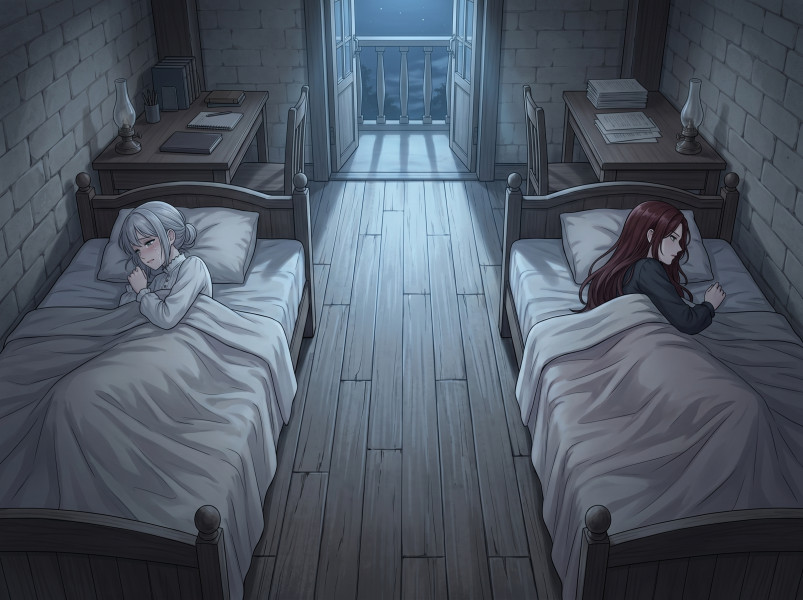
That night, the room seemed smaller than ever.
Samantha went to bed first. She had been quiet all evening, not cold, not unkind, only tired in a way Lily recognised too well now. After extinguishing the brighter lampstone, she offered Lily a soft good night and turned onto one side, facing the wall.
Lily answered automatically.
The darkness that followed was not complete. A thread of moonlight came through the partly open window, enough to draw thin silver lines along the floorboards and the edge of Samantha's bed.
For a while, Lily lay rigidly still, as if immobility might keep the thoughts from reaching her.
It did not.
The week came back in fragments. The cloister. Samantha's face going still. The lecture hall. The blank page. The room, night after night. Each memory tightened something until even breathing felt like work.
She pressed the heel of one hand against her mouth.
That did not help either.
The first tear arrived less like weeping than like failure. Heat gathered behind her eyes, sharp and humiliating. She blinked hard against it. Then another came. Then another. Soon, the pillow beneath her cheek had gone damp in a shape she refused to acknowledge.
She made no sound at first.
Then a small, frayed breath escaped her before she could stop it.
Lily went still in horror and turned her face further into the pillow, listening.
Across the room, Samantha did not move.
Perhaps she was sleeping.
Perhaps she was only kind enough to pretend.
The possibility of either undid Lily more thoroughly than certainty would have.
She shut her eyes. Her throat hurt. The tears kept coming anyway, hot and stubborn and mortifyingly young.
At some point, a sound slipped out of her that was too small to be called a sob and too broken to be anything else.
"I am sorry," she whispered into the pillow, scarcely more than breath.
No answer came.
The silence stayed exactly where it was.
Lily swallowed and tried to stop. Failed. After a while, the apology came again, worn thinner.
"I am sorry," she breathed.
Still nothing.
Only the sea-wind at the window. The settling of old beams. Samantha's quiet, unreadable stillness across the room.
By the time exhaustion finally dragged her under, Lily's face ached, her chest felt flayed hollow, and the silence between the beds remained unbroken.
It had not become the wide, ancient emptiness she had carried through the archives for centuries.
It was narrower now. Sharper. More humiliating.
It had Samantha's exact outline.
ns216.73.216.236da2

 → Request update
 and then Add to home screen.