
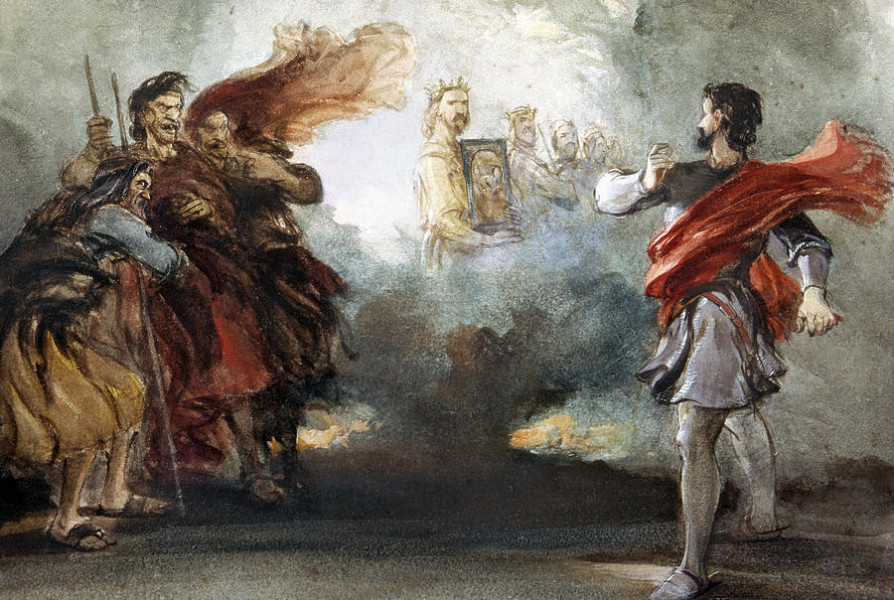
The play Macbeth, written by William Shakespeare, is a drama masterpiece. Written in 1606, he dedicated it to James I, who had been King of England for three years. Like Shakespeare’s other plays, the storyline of Macbeth was not original. He based it on Raphael Holinshed’s Chronicles of England, Scotland, and Ireland, which was published in 1577 (Resources).
Holinshed contained the story of Macbeth and Duncan, Scotland’s medieval kings, but Shakespeare did not use them to write his drama. Instead, he decided to combine different versions of Holinshed’s Chronicles and a bit of Celtic tradition. Raphael Holinshed included in them an account of King Malcolm, who reigned from 1005 to 1034. His throne had first been passed to Duncan I, who reigned from 1034-1040, and then to the real Macbeth, who reigned from 1040-1057. Both he and Duncan were Malcolm’s grandsons, and in the end, all three rulers played important roles in Shakespeare’s play (Parklands).
Despite Macbeth being based on the Chronicles, Shakespeare’s Macbeth and the real Macbeth share both differences and similarities. Not much is known about the real Macbeth because he is mostly portrayed as the ambitious, power-hungry murderer in the play.
Macbeth’s real name was Mac Bethad mac Findlaich, and he was the king of Scotland whose reign was marked by efficient government and the promotion of Christianity (Biography). He was born in Moray, Celtic during a time of civil war (Octane Seating). Natively, he was Gaelic, and his name in Gaelic means “Son of Life (Biography).”
When Macbeth was fifteen years old, his father, known as “Mormaer of Moray,” died, and he was taken in by his grandfather, King Malcolm of Scotland. Fourteen years after his father’s death, in 1034, Malcolm passed away, leaving his throne to another grandson, Duncan (Octane Seating). According to Octane Seating, “Duncan became deeply involved in Anglo-Norse affairs and was involved in many failed conflicts against England,” which eventually led to Macbeth killing him in battle near Elgin, Morayshire, in August 1040 (Biography).
Macbeth, believed to have been a “strong and respected warrior,” ruled for 14 years and appears to have ruled equitably by imposing laws and order and encouraging Christianity. In 1046, Siward, earl of Northumbria, unsuccessfully attempted to dethrone him in favor of Malcolm III (Totally History).
Macbeth’s reign ended when he was killed in battle by Malcolm, who had support from the English. It is said that Malcolm III beheaded him before he took his remains to Iona for burial (Totally History).
As he is portrayed in the play, Shakespeare’s Macbeth was not a hero or honorable king (as the real Macbeth was)—he was a murderer. Historical Macbeth did murder people, but unlike fictional Macbeth, he did not do so constantly just to stay on the throne. There is a similarity between the two: they were both power-hungry. They wanted to become the next king and rule for a long time. Historical Macbeth achieved this by winning leadership of his people, mostly through nonviolent means. Macbeth in Shakespeare’s play did not achieve this goal, though. Instead of winning his people’s leadership, they feared him because he was so evil and killed many people (Teen Ink). Despite this huge difference, though, both Macbeths were thirsty for power and tried everything they could to become better kings, but only historical Macbeth succeeded more than fictional Macbeth.
An example of Macbeth's thirst for power in Shakespeare’s portrayal is when he meets with the three witches again in Act 4, Scene 1, and sees the apparitions.
During the meeting, he says, “Then live, Macduff. What need I fear of thee? But yet I’ll make assurance double sure, and take a bond of fate. Thou shalt not live, that I may tell pale-hearted fear it lies, and sleep despite thunder (462),” which translates to “Then I don’t need to kill Macduff. I have no reason to fear him. But even so, I’ll make doubly sure. I’ll guarantee my own fate by having you killed, Macduff. That way I can conquer my own fear and sleep easily at night (Sparknotes).” The line shows Macbeth’s dark side. He thinks that if he kills more people, then he will become the ultimate ruler of Scotland. Historical Macbeth did not think that way. He just wanted to encourage Christianity and make Scotland a better place.
Something else that is very different between the two Macbeths is the fictional Macbeth’s relationship with Lady Macbeth. Historical Macbeth is said to have had a strong, loving relationship with his wife, a woman known as Grouch (Teen Ink). Their relationship is portrayed quite differently in Shakespeare’s Macbeth. Throughout the whole play, especially in Act 5, Scene 5, a close look at Macbeth’s and Lady Macbeth’s relationship is shown, and it is safe to conclude that Macbeth most likely never really loved Lady Macbeth in the first place.
In Act 5, Scene 5, when Seyton runs to Macbeth and tells him Lady Macbeth is dead, he responds with his famous “Tomorrow” monologue, “She should have died hereafter. There would have been a time for such a word. Tomorrow, and tomorrow, and tomorrow, creeps in this petty pace from day to day to the last syllable of recorded time, and all our yesterdays have lighted fools the way to dusty death. Out, out, brief candle! Life’s but a walking shadow, a poor player that struts and frets his hour upon the stage and then is heard no more. It is a tale told by an idiot, full of sound and fury, signifying nothing (486),” which translates to, “She would have died later anyway. That news was bound to come someday—tomorrow, and tomorrow, and tomorrow. The days creep slowly along until the end of time. And every day that’s already happened has taken fools that much closer to their deaths. Out, out, brief candle. Life is nothing more than an illusion. It’s like a poor actor who struts and worries for his hour on the stage and then is never heard from again. Life is a story told by an idiot, full of noise and emotional disturbance but devoid of meaning (Sparknotes).” The monologue explained to the audience that Macbeth was ready for Lady Macbeth to die—that it would eventually happen—and that his path to remain in power was now clear. He did not sound at all disappointed when he heard the news of Lady Macbeth’s passing. That can lead to people wondering if he really loved her, and if he did, did she love him back?
A key inaccuracy with the two Macbeths is how they died. In the play, Macduff murdered Macbeth because he was enraged when he learned that Macbeth was the one who killed his family. Historically, it was Malcolm III, Duncan’s son, who murdered him. He did this with the hope that he would be able to take Macbeth’s throne, but his plan was ruined. The king’s followers placed Macbeth’s stepson, Lulach, on the throne instead. He only remained king for a few months, though, because Malcolm eventually murdered him as well (Teen Ink). At the end of both the play and the real thing, Malcolm still became king.
Comparing historical Macbeth with fictional Macbeth may lead to the conclusion that the real Malcolm was the one Shakespeare portrayed as fictional Macbeth. Malcolm was the true murderer, not Macbeth. He was the one who was seduced by his own ambitions.
Shakespeare made many changes to his Macbeth, but most were very dramatic and did not distort the historical truth behind it (Teen Ink). One of the most important things is that both historical Macbeth and the play derived from his achievements have impacted history in many ways, most of them very positive.
ns216.73.216.175da2
 → Request update
 and then Add to home screen.