
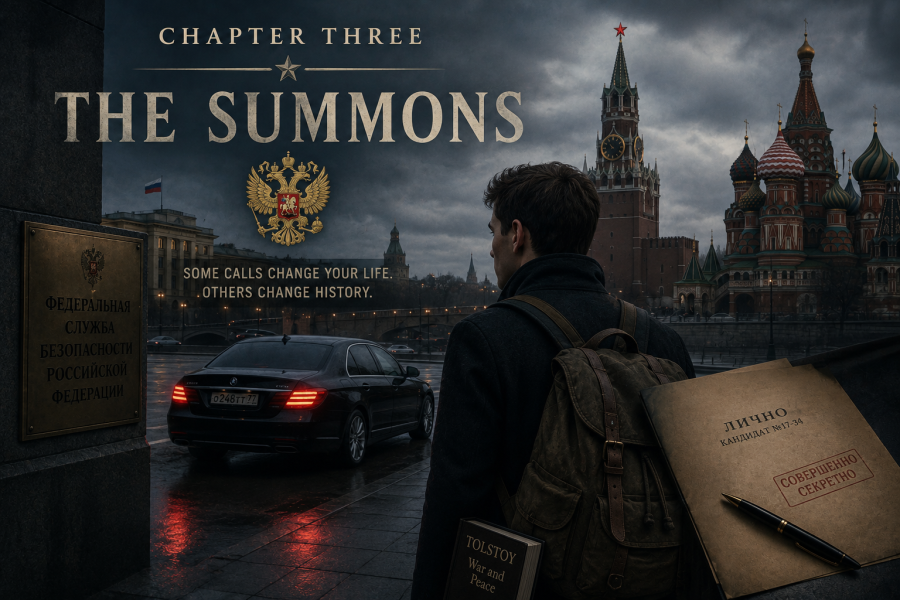
Sleep deserted her long before dawn.
It was not the sharp awakening that follows a nightmare, but the slow realization that the argument of the previous evening had survived the night intact.
Natalya lay motionless, listening.
The apartment was quiet.
No shower.
No kettle.
No footsteps.
Dmitri had already left.
She reached for her phone.
Nothing.
No message.
She set it back on the bedside table and drew aside the curtains.
September sunlight poured across Rostov.
The first commuters were already filling the boulevard below.
A tram rattled toward the city center.
Delivery vans were unloading bread.
Nothing in the scene suggested that, two continents away, hundreds of police officers, wildlife rangers, diplomats, and journalists were combing the Maasai Mara for a missing American singer whose disappearance had become the world's leading story.
Life possessed an extraordinary ability to continue looking ordinary.17Please respect copyright.PENANAcKfeXokGq8
17Please respect copyright.PENANAK9Zb4FQ5db
17Please respect copyright.PENANAQL5TOdIhuX
17Please respect copyright.PENANAV6PTn9f9Gs
She dressed slowly.
The apartment reflected the life they had built together.
Bookshelves crowded with history, literature, and political science.
A modest kitchen.
Plants she insisted on keeping alive despite Dmitri's repeated predictions that they would die.
Photographs from Sochi.
Lake Baikal.
St. Petersburg.
No children.
Not yet.
That subject had become dangerous territory.17Please respect copyright.PENANAEdbX72lyhi
17Please respect copyright.PENANARWY4QVvD5e
17Please respect copyright.PENANAr5zvyc3Rmv
Their disagreement the previous evening had not really been about politics.
Politics had merely supplied the vocabulary.
"You spend more time thinking about the government than thinking about us."
"I work for the government."
"You work near the government."
"There is a difference."
"There used to be."
He had smiled.
She had not.
Then silence.17Please respect copyright.PENANAymw7xpm7Qw
17Please respect copyright.PENANADoaDKr6n6I
17Please respect copyright.PENANAfTUJw6OLVk
Coffee hissed from the espresso machine.
She switched on the television more from habit than curiosity.
Russia 1.
Morning news.
The anchor's tone remained measured.
"Search operations continue in southwestern Kenya for missing American entertainer Demi Lovato."
Satellite images appeared.
Search grids.
Helicopters.
Kenyan police.
American FBI personnel arriving in Nairobi.
A spokesman from the U.S. Embassy.
No speculation.
Only facts.
Natalya watched for perhaps thirty seconds before changing channels.
Business news.
Weather.
Traffic.
She settled on none of them.
The story kept reappearing.17Please respect copyright.PENANAzu7dQlOt9G
17Please respect copyright.PENANADJ0MEao3g0
17Please respect copyright.PENANAZ5F5lClU6p
She remembered when they had first met.
Moscow State University.
He had seemed almost old-fashioned.
Patient.
Thoughtful.
The sort of man who listened before speaking.
Most students argued because they enjoyed winning.
Dmitri argued because he genuinely wanted to understand.
That quality had attracted her.
It still did.
What frightened her now was that he had recently begun keeping things to himself.
Not lying.
Simply...
editing.
Entire subjects disappeared from conversation.
Phone calls were taken in another room.
Travel plans changed without explanation.
When she asked, he would smile apologetically.
"I'll tell you when I can."17Please respect copyright.PENANAyODNqZ6AKC
17Please respect copyright.PENANAMbEltL4urE
17Please respect copyright.PENANAd0s7x4IagW
By midmorning she walked to the neighborhood bakery.
The television above the counter carried Euronews.
Again, the Kenyan story.
The headline had changed.
SEARCH ENTERS SIXTH DAY
A customer glanced upward.
"Poor girl."
Another shrugged.
"They'll find her."
The cashier switched channels to football highlights.
Life resumed.17Please respect copyright.PENANAED9qvVAf14
17Please respect copyright.PENANAIP35xxou2K
17Please respect copyright.PENANAeq75dyjYSh
17Please respect copyright.PENANAsgPuigLXOp
Far to the south, however, events were already beginning to accelerate.
Aircraft searched new sectors.
Forensic teams arrived from Nairobi.
Fresh footprints had been located near a seasonal river crossing.
Baran Talabani had canceled all remaining interviews to accompany investigators into the reserve himself.
No one in Rostov knew any of this.
Certainly not Natalya.
She paid for her bread, stepped back into the warm September sunshine, and headed home.
Behind her, unnoticed on the muted television, the scrolling headline changed once more.
KENYAN AUTHORITIES TO HOLD AFTERNOON PRESS CONFERENCE.
Within forty-eight hours, the search would become a recovery.
Within seventy-two, the world would know her name not as an entertainer missing in Africa...
...but as the victim whose death would divide history into a before and an after.
And somewhere else in southern Russia, Dmitri was already traveling toward a future whose connection to that distant Kenyan savanna he still could not possibly imagine.17Please respect copyright.PENANANXo92ItaxQ
17Please respect copyright.PENANAqMe5kghDfT
17Please respect copyright.PENANA6XTKpmLyx3
17Please respect copyright.PENANAIxjCJ67sW8
17Please respect copyright.PENANAHWKxjc9zgR
Irina lingered among the orchids longer than she intended.
The conservatory had always been the quietest place on the estate. Moist warmth fogged the glass, and the smell of damp earth drowned out every other scent. Outside, September sunlight washed across the lawns and birch groves. Inside, time seemed to move more slowly.
She stopped beside a white moth orchid whose blossoms had opened only two days earlier.
"Beautiful," she whispered.
Beauty, she reflected, demanded constant care. Leave a greenhouse unattended for a week and disease spread invisibly from leaf to leaf until the entire collection suffered. Human lives, she sometimes thought, obeyed the same law.
Her phone vibrated.
Not Roman.
One of the estate managers.
She answered.
"Yes?"
"The irrigation contractor is here."
"I'll be there shortly."
"And... there's something else."
He hesitated.
"The television crews are gathering again."
Irina closed her eyes.
"For what?"
"The American singer."
She frowned.
"What now?"
"They've recovered additional evidence in Kenya."
She said nothing.
The manager continued carefully.
"Every network is carrying it."
Roman was already in his study.
He had not slept much.
Three laptop screens glowed across his walnut desk. Financial markets filled one. Agricultural futures another. The third showed a muted twenty-four-hour news channel.
Images from the Maasai Mara cycled endlessly.
Police tape.
Military tents.
Satellite trucks.
Helicopters.
The same photographs repeated every fifteen minutes.
He muted it again.
The entire world had become obsessed with one crime.
"It'll pass," he muttered.
His assistant entered carrying coffee.
"The Rostov conference confirmed."
Roman nodded.
"And?"
"The ministry called."
Roman looked up.
"They've postponed tomorrow's meeting."
"Why?"
"They didn't say."
A pause.
"They simply said... events in East Africa are occupying everyone's attention."
Roman leaned back.
"So now even Moscow can't think about anything else."17Please respect copyright.PENANAmKXTTjM82J
17Please respect copyright.PENANAQqMQS2P5au
17Please respect copyright.PENANA5wnJXF0MA8
17Please respect copyright.PENANAF6EPZkhtpu
Irina found him there twenty minutes later.
He did not immediately acknowledge her.
Only after another headline crossed the television did he finally speak.
"They're calling it an assassination now."
"It was always an assassination."
"Perhaps."
"They're treating it as something larger."
Roman gave a dry laugh.
"American television treats everything as larger."
"They've closed part of the Maasai Mara."
"I heard."
She studied him.
"You don't seem surprised."
"I've spent enough time around government people to recognize the beginning of an international crisis."
He gestured toward the television.
"Look at it."
"The Americans have dispatched investigators."
"NATO governments are issuing statements."
"The British are demanding answers."
"The Kenyans have sealed hundreds of square kilometers."
He shook his head.
"Whatever happened over there wasn't ordinary."17Please respect copyright.PENANAqIhMmU2nkV
17Please respect copyright.PENANAJUh4vMusKr
17Please respect copyright.PENANAsqZLzv9zgA
17Please respect copyright.PENANAkNTzBUDYj8
Neither of them noticed the chauffeur entering quietly.
"Excuse me."
Roman nodded.
"What is it?"
"A visitor."
"Who?"
"Mr. Zakhar."
Roman's expression hardened.
"My father?"
"Yes."
"He arrived without notice."
Irina glanced toward the window.
An aging black Mercedes stood beneath the birches.
Zakhar stepped out without waiting for anyone to open the door.
He still carried himself like a man who had built everything with his own hands.
He entered the house already talking.
"I've driven three hours because apparently nobody in this family answers a telephone."
Roman sighed.
"What emergency brings you here?"
"The markets."
"I've already seen them."
"No."
Zakhar pointed toward the television.
"That."
Roman looked again at the aerial photographs from Kenya.
"I don't invest in pop singers."
"You invest in stability."
Silence.
Zakhar continued.
"I've lived long enough to recognize when governments stop acting normally."
"They're acting exactly as governments always do."
"No."
He folded his arms.
"They're frightened."
Roman almost smiled.
"Over one murdered celebrity?"
Zakhar answered quietly.
"No."
"Over whoever was willing to murder her."17Please respect copyright.PENANAbLG7a2Q1KN
17Please respect copyright.PENANAC3CL9QjEej
17Please respect copyright.PENANAJNWa3cGtCX
17Please respect copyright.PENANAq8oKzKYHp7
Elsewhere, more than four thousand kilometers away, the first convoy departed Narok County Hospital under armed escort.
Its destination was not yet announced publicly.
The recovered evidence—personal effects, forensic samples, and the victim's belongings—would travel under continuous military protection toward Nairobi.
Waiting outside the hospital gates stood journalists from nearly every major international broadcaster.
Among them was a young Kurdish correspondent whose accreditation still identified him by another assignment.
Baran Talabani adjusted the microphone in his hand.
His producer counted down.
"You're live in five..."
He took one last look toward the convoy disappearing into the Kenyan afternoon.
No one watching yet knew his name.
Within days, his reporting from the Maasai Mara would make him one of the most recognizable war correspondents on Earth.

 → Request update
 and then Add to home screen.